Early Years Learning Framework
The Early Years Learning Framework (EYLF) is Australia’s national guide for early childhood education, supporting children’s learning from birth to five years of age. It sets out the principles, practices, and learning outcomes that educators follow to create engaging, play-based environments where children thrive — framed around the ideas of Belonging, Being, and Becoming. For parents in Goulburn, understanding the Early Years Learning Framework can help you feel more confident when choosing childcare and knowing how services support your child’s growth.
What is the Early Years Learning Framework?
The Early Years Learning Framework was first introduced in 2009 and updated in 2023 (Version 2) to reflect modern research and best practice. It is not a rigid curriculum but a flexible framework that provides educators with a shared language and understanding of how young children learn. Every approved childcare service in Australia — from long day care and preschools to family day care — is required to use the EYLF as part of the National Quality Framework.
By focusing on the whole child, the framework ensures that children are given meaningful opportunities to explore, connect, and develop at their own pace. It values the uniqueness of childhood, recognising that the early years lay the foundation for lifelong learning, wellbeing, and active citizenship.
Belonging, Being & Becoming in the EYLF
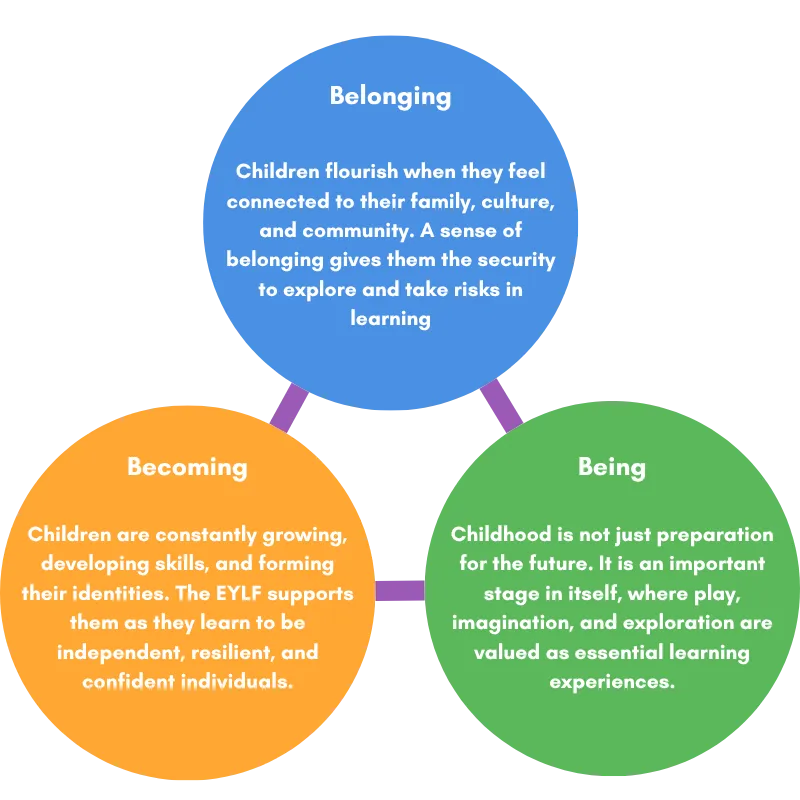
At the heart of the Early Years Learning Framework are three simple but powerful concepts:
- Belonging – Children flourish when they feel connected to their family, culture, and community. A sense of belonging gives them the security to explore and take risks in learning.
- Being – Childhood is not just preparation for the future. It is an important stage in itself, where play, imagination, and exploration are valued as essential learning experiences.
- Becoming – Children are constantly growing, developing skills, and forming their identities. The EYLF supports them as they learn to be independent, resilient, and confident individuals.
The 8 Principles of the EYLF
The Early Years Learning Framework is built on eight guiding principles that shape quality practice. These principles also help parents understand what to expect from a high-quality service:
- Secure, respectful and reciprocal relationships — Children learn best when they feel safe, understood, and valued through trusting, responsive relationships with educators.
- Partnerships — Educators and families work together, recognising that parents are children’s first and most influential teachers, and collaboration supports stronger outcomes.
- Respect for Diversity — Children and families are welcomed, included, and celebrated for their cultural, linguistic, family, gender, and ability diversity.
- Aboriginal and Torres Strait Islander Perspectives — Services actively embed First Nations perspectives, honouring Country, culture, and identity, and supporting truth-telling and reconciliation.
- Equity, Inclusion and High Expectations — Every child can learn and has the right to access, participate, and succeed, with educators removing barriers and promoting fairness and opportunity.
- Sustainability — Educators model social, cultural, and environmental responsibility, helping children care for people, place, and the planet now and into the future.
- Critical Reflection and Ongoing Professional Learning — Educators continuously reflect on their practice, challenge bias, and seek professional growth to improve learning and wellbeing outcomes.
- Collaborative Leadership and Teamwork — When leadership is shared and teams communicate openly, children benefit from consistent, high-quality programs and emotionally safe environments.
Child Care Guide offer a detailed analysis of the Principles of the EYLF
Effective Practices in the Early Years Learning Framework
The EYLF outlines key practices that bring the principles to life. When you visit a service in Goulburn, you might notice these in action:
- Holistic approaches – Focusing on physical, social, emotional, and cognitive growth together.
- Responsiveness to children – Programs adapt to children’s interests and emerging skills.
- Learning through play – Play is the foundation for creativity, problem-solving, and relationship building.
- Intentional teaching – Educators step in with questions, resources, or guidance to extend learning.
- Cultural competence – Daily practices reflect and respect children’s cultural identities.
- Continuity of learning – Smooth transitions between home, childcare, and school are supported.
- Assessment for learning – Educators document learning to plan meaningful next steps.
The Five Learning Outcomes
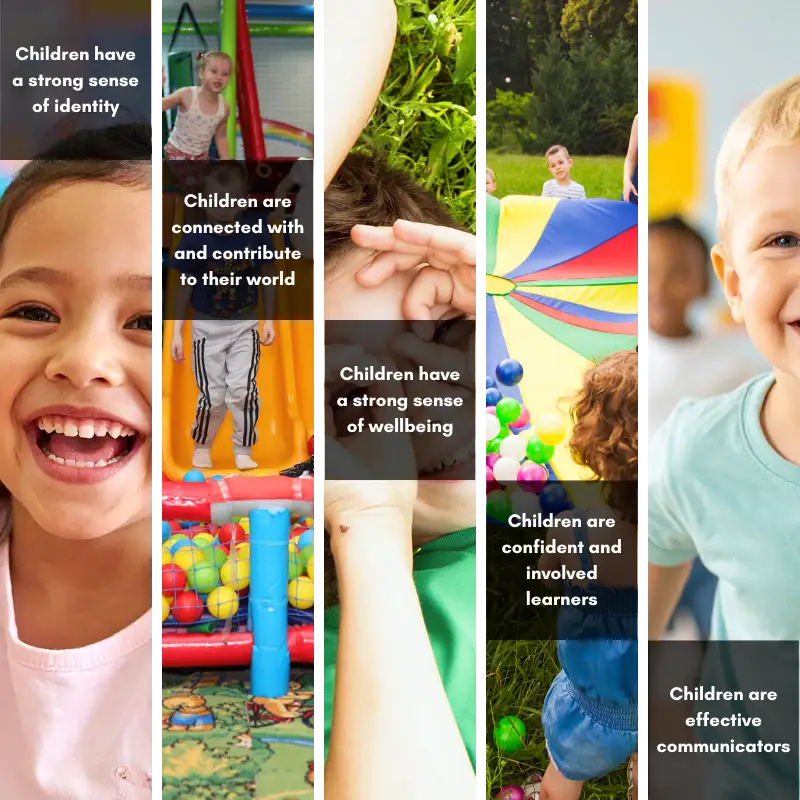
The Early Years Learning Framework describes five outcomes that all children should be working toward. These outcomes give families a clear picture of how learning is progressing:
- Children have a strong sense of identity — Feeling safe, secure, and supported.
- Children are connected with and contribute to their world — Building respect, fairness, and responsibility.
- Children have a strong sense of wellbeing — Developing resilience, physical skills, and healthy habits.
- Children are confident and involved learners — Showing curiosity, persistence, and creativity.
- Children are effective communicators — Building language, literacy, and numeracy skills while expressing themselves clearly.
How the EYLF Connects to the National Quality Framework
The Early Years Learning Framework sits within the broader National Quality Framework (NQF). Together, they ensure that all childcare services in Australia are held to consistent standards. The EYLF provides the learning goals, while the NQF regulates safety, staffing, and quality assurance. For Goulburn families, this means confidence that every approved service is working toward the same outcomes.
Practical Tips for Parents
The Early Years Learning Framework is not just for educators — parents can also apply its ideas at home. Some simple ways to support your child’s early learning include:
- Encourage play with open-ended toys and plenty of free time.
- Talk about your child’s experiences and ask questions to build language.
- Celebrate cultural traditions at home and share them with your child’s educators.
- Support healthy routines such as mealtimes, outdoor play, and sleep.
- Review your child’s learning portfolio or stories from educators and extend them at home.
Final Thoughts
The Early Years Learning Framework is a cornerstone of Australia’s early childhood education system. For families in Goulburn, it reassures parents that childcare and preschool services are focused on building strong foundations in belonging, wellbeing, and lifelong learning. By understanding how the EYLF works, you can feel confident that your child’s early years are setting them up for future success.
Frequently Asked Questions about the EYLF
Q: What is the Early Years Learning Framework?
A: The Early Years Learning Framework (EYLF) is Australia’s national guide for early childhood education, supporting children’s learning from birth to five years of age.
Q: Is the Early Years Learning Framework a strict curriculum?
A: No. The EYLF is a flexible guide that helps educators plan meaningful learning experiences rather than follow a rigid, scripted curriculum.
Q: Has the Early Years Learning Framework recently changed?
A: Yes. Version 2 of the EYLF was endorsed in 2023, reflecting updated research, contemporary practice, and a stronger focus on inclusion and cultural responsiveness.
Q: Do parents need to know about the EYLF?
A: It helps. Understanding the Early Years Learning Framework gives families confidence to ask informed questions and see how their child’s learning and wellbeing are supported through everyday play and routines.




Other Childcare Sites


Page updated: November 11, 2025